
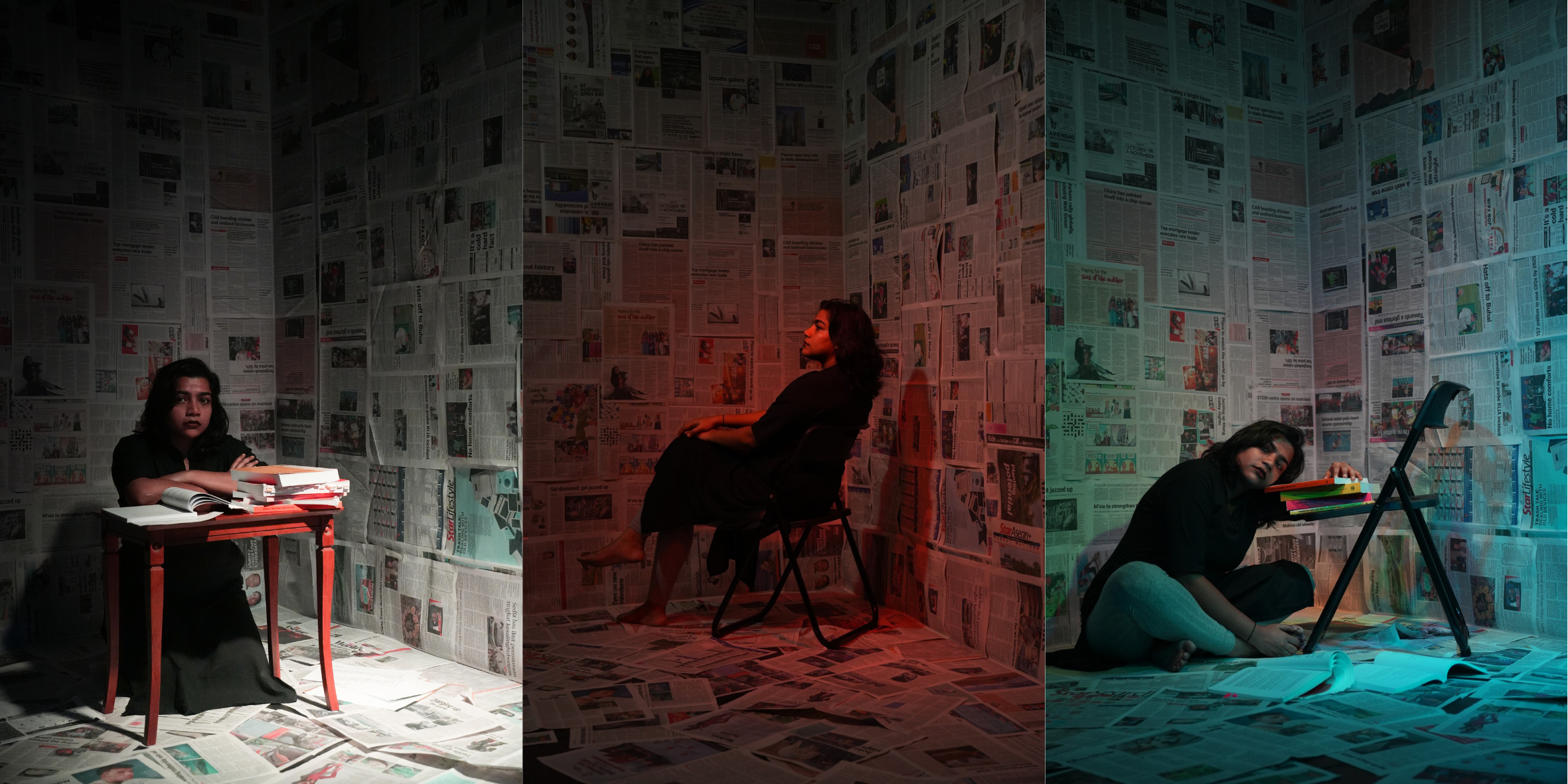
Some people make art to share their world views. Others make art to confront realities we would rather not face. Sitting in the dark at the Five Arts Centre in GMBB, Pudu, watching Tali Tukang Gantung unfold, I felt unmistakably that I was in the presence of the latter kind.
For four sold-out performances, this lean 60-minute production opened a door that is usually kept shut. It invited us into courtrooms, holding cells and prison corridors as it traced the trials and tribulations of life on death row through the eyes of inmates, lawyers and judges.
Penned by activist and playwright Effa Qamariani, the play is carried almost entirely by the captivating solo performance by actor and poet Deena Dakshini. It was my first time seeing her on the stage but she was a somewhat familiar name in the arts, with her works often focusing on marginalised communities and topics such as neurodivergence and sexuality. Over the course of Tali Tukang Gantung, Deena shapeshifts through multiple lives shaped by the criminal justice system, flickering seamlessly between authority and fragility, rage and resignation.
Each transformation – whether in language or position of authority – seems to ask the audience to reconsider who is allowed complexity and who is reduced to a case file.
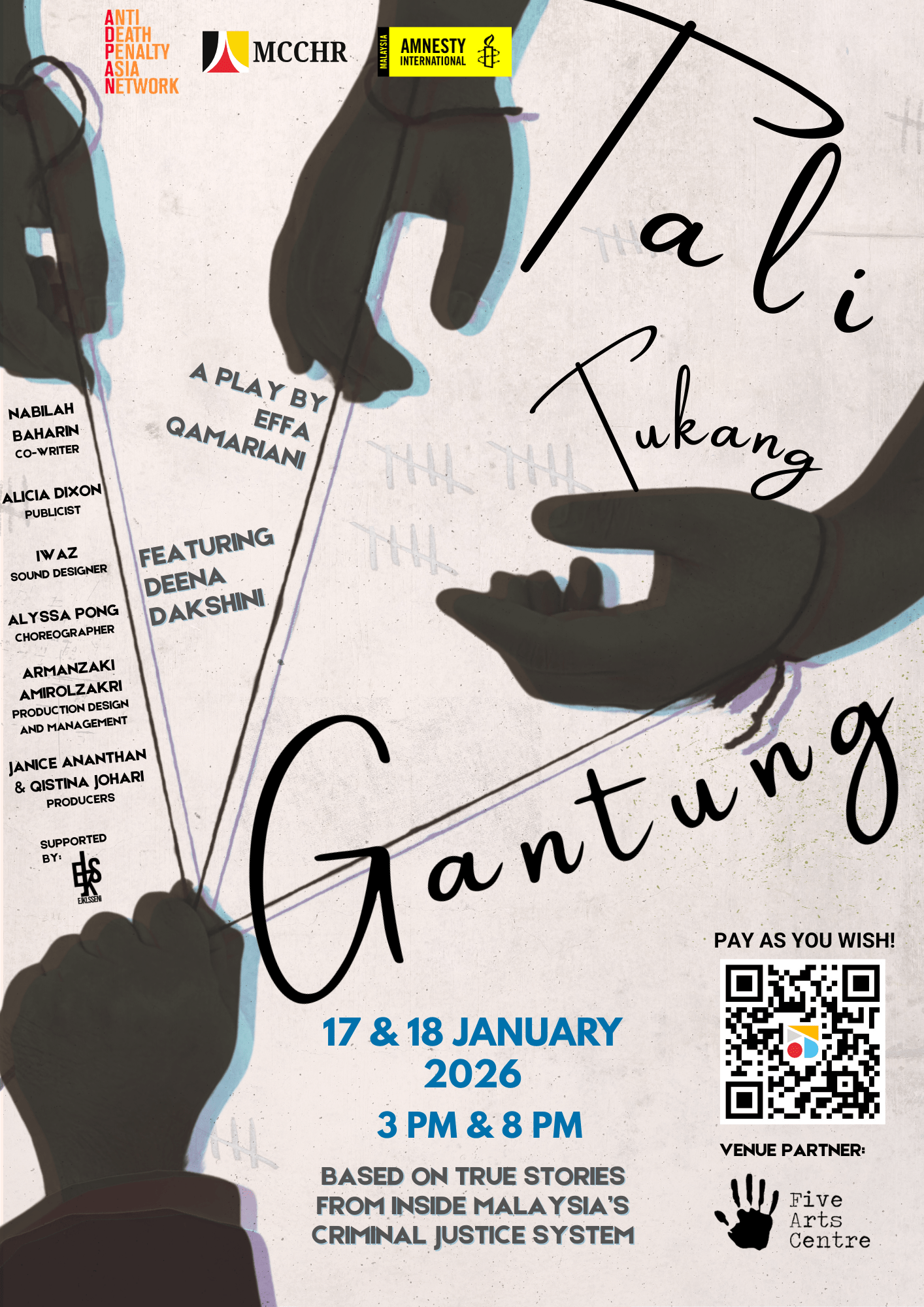
Coming home from the play, one of the characters that lingered on my mind was Nina, a traveller from Hong Kong who faced a great deal of obstacles due to a language barrier between her and the authorities.
A Cantonese speaker, she arrives in Malaysia believing that multiculturalism might offer her common ground as a traveller. Yet, she found herself isolated from the day of her arrest all the way to the courtroom. No one spoke her language or ever fully explained what crime she had committed, signing papers she did not understand, caught in a system that did not serve the layman like her.
Sound designer Iwaz and production manager Armanzaki Amirolzaki deserve applause for shaping the emotional frame of the piece. Their poignant use of music and lighting allowed the play to breathe in tense points of the story. Sometimes even fracturing it into unexpected moments of comic relief, as though using humour as a sort of coping mechanism.
The production draws inspiration from Gogularaajan Rajendran’s micro-documentary Araro Ariraro, which revived Tamil folk songs once sung by Indian plantation workers in colonial Malaysia. These are songs that kept alive the voices of communities history tried to erase. That same spirit of preservation runs through the play’s use of oppari, a traditional Tamil lament sung at funerals. Communal and unrestrained, oppari acted as a way of speaking injustice aloud, of carrying grief that ordinary language cannot hold. Here, it becomes a form of truth-telling, saying what the legal system cannot, and giving weight to the families who bear punishment alongside the accused.
You will hear it at its most raw in the transition from Act 2 to Act 3. It works as a cry on behalf of mothers, families, and communities grieving not only executions, but uncertainty, silence, and systemic neglect. The rest of the soundtrack includes Saloma’s Muda Manja, Monita Tahalea’s Cita-Cita, November Ultra’s cover of The Winner Takes It All, an eclectic but equally deliberate selection of songs.
But the most haunting figure is Sangeetha, an underage bride condemned to death for killing her husband. She was seventeen when it happened: married to a twenty-eight-year-old, pregnant, and then not. Crushed beneath the weight of societal expectation and a grief for an unborn child she had no language for, she watched her husband slip into an affair with his boss. She began tracking his movements, so visibly consumed that vendors at the market her husband worked believed she had lost her mind. Perhaps she had, but her madness had a plan. She meant to kill the lover, not the husband. The dagger was never meant for him but in a crucial moment, he stepped into its path, protecting his lover. Watching Deena inhabit Sangeetha, I was struck by how devastating her psychological unravelling was.
At every step of the way, she was isolated – from when she was married off to her husband all the way to her prison. This led to the gradual erosion of her sense of self under unbearable emotional pressure – none of which should be faced by a child. By the time she reaches death row, guilt becomes a kind of permanent mental imprisonment. The extenuating circumstances of her crime should have stood for something but somehow it didn’t. To me, it seemed like every person who should have protected her looked away, and the law was the very last in a long line.
Putting the play together
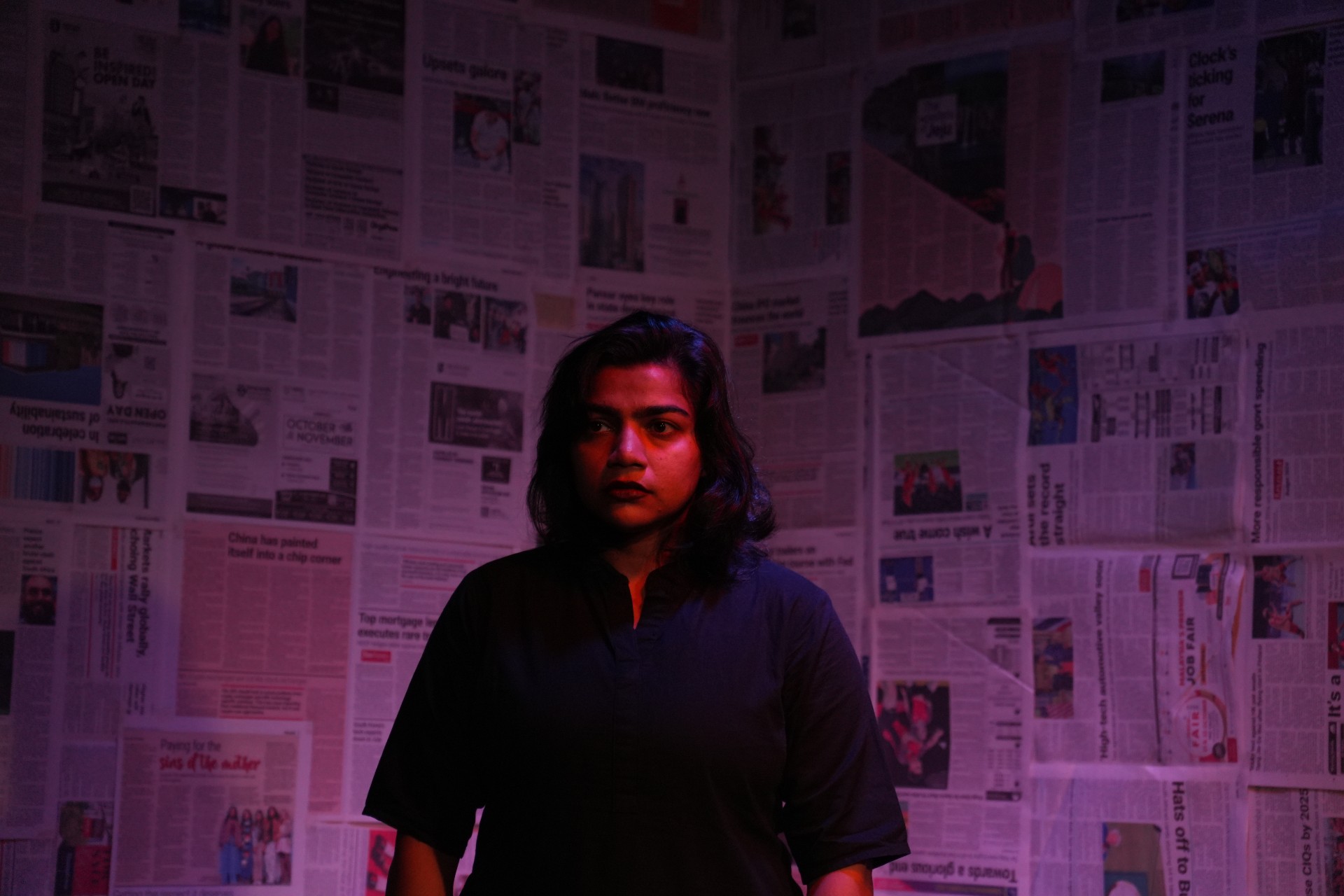
What makes Tali Tukang Gantung so compelling is its refusal to isolate these stories from the structures that produce them, knowing that Malaysian Indians, in particular, are overrepresented on death row. The script also exposes the logic of presumption within the legal system where the possession of a certain quantity of drugs can translate into an assumption of trafficking and the accused can feel guilty before innocence is even conceivable.
When I spoke to producer Janice Ananthan, also a Project Officer at the Anti Death Penalty Asia Network (ADPAN), she explained that the script was shaped by interviews with lawyers, academics, activists, journalists, former inmates, and members of prison communities, among them Datuk N. Sivananthan, Sangeet Kaur Deo, Salim Bashir, Dr. Thaatchaayini Kananatu, and Martin Vengadesan. The play also would not exist without the years of research and advocacy carried out by the NGOs behind it: Amnesty International, the Anti-Death Penalty Asia Network (ADPAN), and Malaysian Centre for Constitutionalism for Human Rights (MCCHR).
But research alone does not make a play. For Deena, who was also involved in shaping her characters, the work was less about gathering information than translating it. Her involvement centred on rendering dense legal and human rights knowledge into accessible language a performer could embody, and an audience of any background could receive.
“I don’t come from an advocacy background, although I strongly believe in it. It is part of my philosophy to always use art to disturb the comfortable and comfort the disturbed,” she said, calling herself a mediator between the research and the viewer.
“Most of my involvement was making sure that, as a performer, I’m able to convey the message to the audience. I had to understand what the advocacy was trying to convey, and what the audience should receive.”
Why stage Tali Tukang Gantung now?
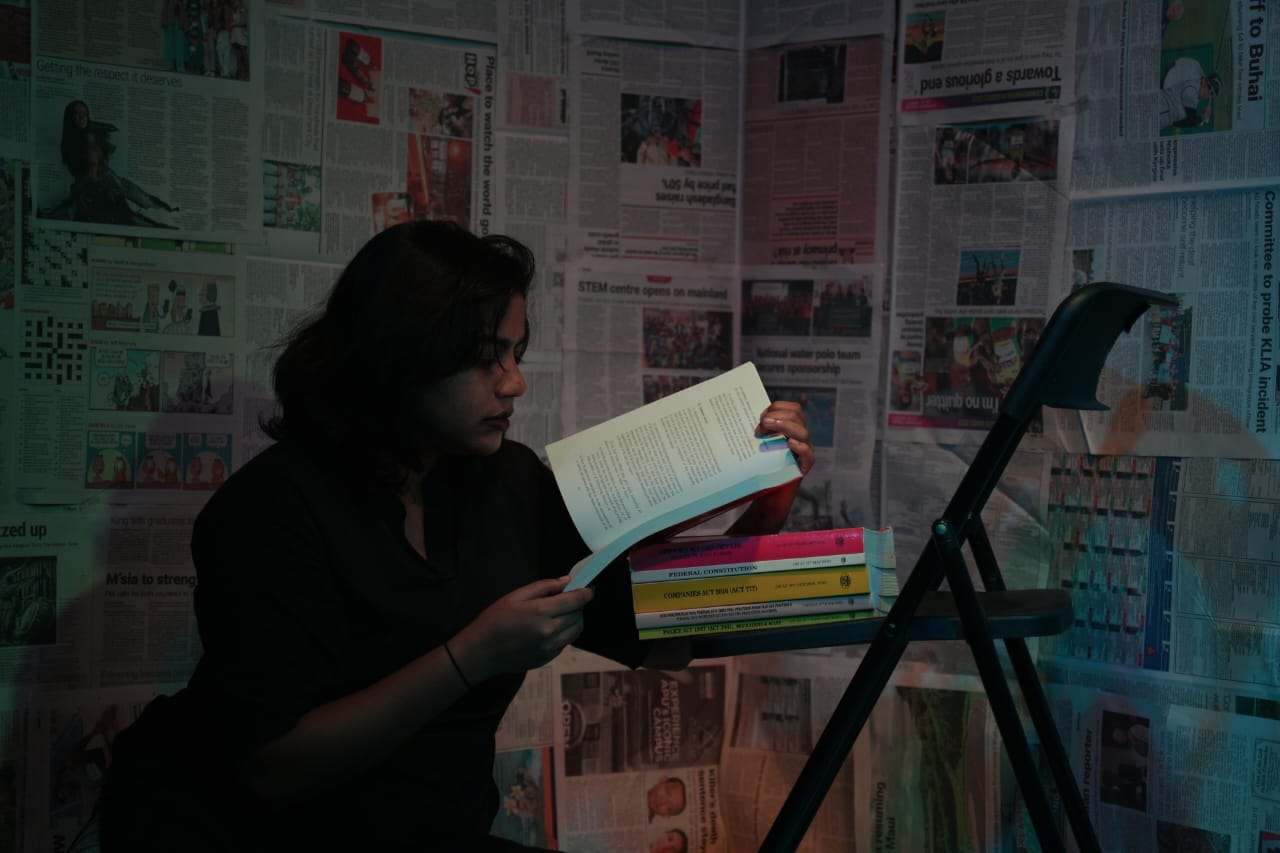
Tali Tukang Gantung emerged from a broader shift among Malaysian civil society organisations towards more creative forms of campaigning, which we have seen in initiatives by Amnesty International Malaysia and Freedom Film Network to campaign for human rights through the arts. The production is one part of that effort. Contributions collected during the show go toward funding creative writing workshops for the prison community.
Effa describes the production as an attempt to reach beyond the usual audiences of human rights advocacy.
“We cannot afford to only preach to the choir, right? We have to make the choir sing, and then we have to spread the word some more. So this is our way to do it,” she said in our interview.
For Janice, the move towards theatre builds on years of collaboration and chemistry between the organisations.
“Over the past two years we have been doing press conferences, a lot of efforts like panel discussions. So Tali Tukang Gantung is really one of our efforts to diversify our advocacy campaigns because there’s a lot of ways to campaign,” she said, adding that theatre offers a way to translate complex issues into something more accessible.
“When we put out research, when we put out articles, it can be quite longwinded… this is one way in which we hope to be able to show the public what are actually the issues in our criminal justice system.”
Tali Tukang Gantung opened in the shadow of two significant losses for the anti-death penalty movement: the execution of Malaysian death row inmate Pannir Selvam last October, and the death of Singaporean human rights lawyer M. Ravi last December. Ravi spent decades representing death row inmates, including several Malaysians, and was widely regarded as one of the region’s most fearless advocates against capital punishment.
“It’s a very urgent time. I know in Malaysia, of course, we are not actively hanging, and there is a moratorium.
“So in Malaysia, no, but it is very important for us to continue to add pressure in whatever way, shape or form. So this is one way for us to go about that, because the media attention is there.
“Pannir’s case, which has been so big and so public with the book launch as well. That was very helpful, because it really tugged on people’s heartstrings, to see the human side of the inmates,” said Janice.
“How do we continue the momentum to continue advocating? Because it’s so easy for us, especially as abolitionists, to feel kind of demotivated, to feel like… I don’t want to say ‘What is the point?’ [but] we’re only human, and you almost feel like we’ve done so much, and [the end result] is still not what we want.
“But we have to learn how to continue to motivate ourselves and push ourselves and to focus on our work and what we can do. Because I believe, and I hope, with time, with our sustained efforts and sustained pressure, that this does help to address certain misconceptions that the public might have,” added Janice.
That sustained pressure takes many forms, and in this production, one of them is perspective. The largely female creative team brought a gendered lens to the material that the system itself rarely affords. It shows in the details: Nina, cut off by language barriers, endures the hot flashes of menopause without aid or acknowledgment, a reminder of how thoroughly women’s bodies and interior lives are erased within legal narratives. It is a small moment, but a pointed one. The law does not account for what it cannot see.
Malaysia has made notable progress in recent years. The abolition of the mandatory death penalty in 2023, the reduction of death row inmates and growing judicial discretion are significant steps in the anti-death penalty movement. But watching Tali Tukang Gantung reminds us that progress on paper does not always reach the people it was meant for, leaving us sitting with the question of what we owe them in the meantime.
Tali Tukang Gantung ran for a weekend on 17-18 January 2026 at Five Arts Centre, GMBB.
Image Credits: Tali Tukang Gantung

Leave a Reply