
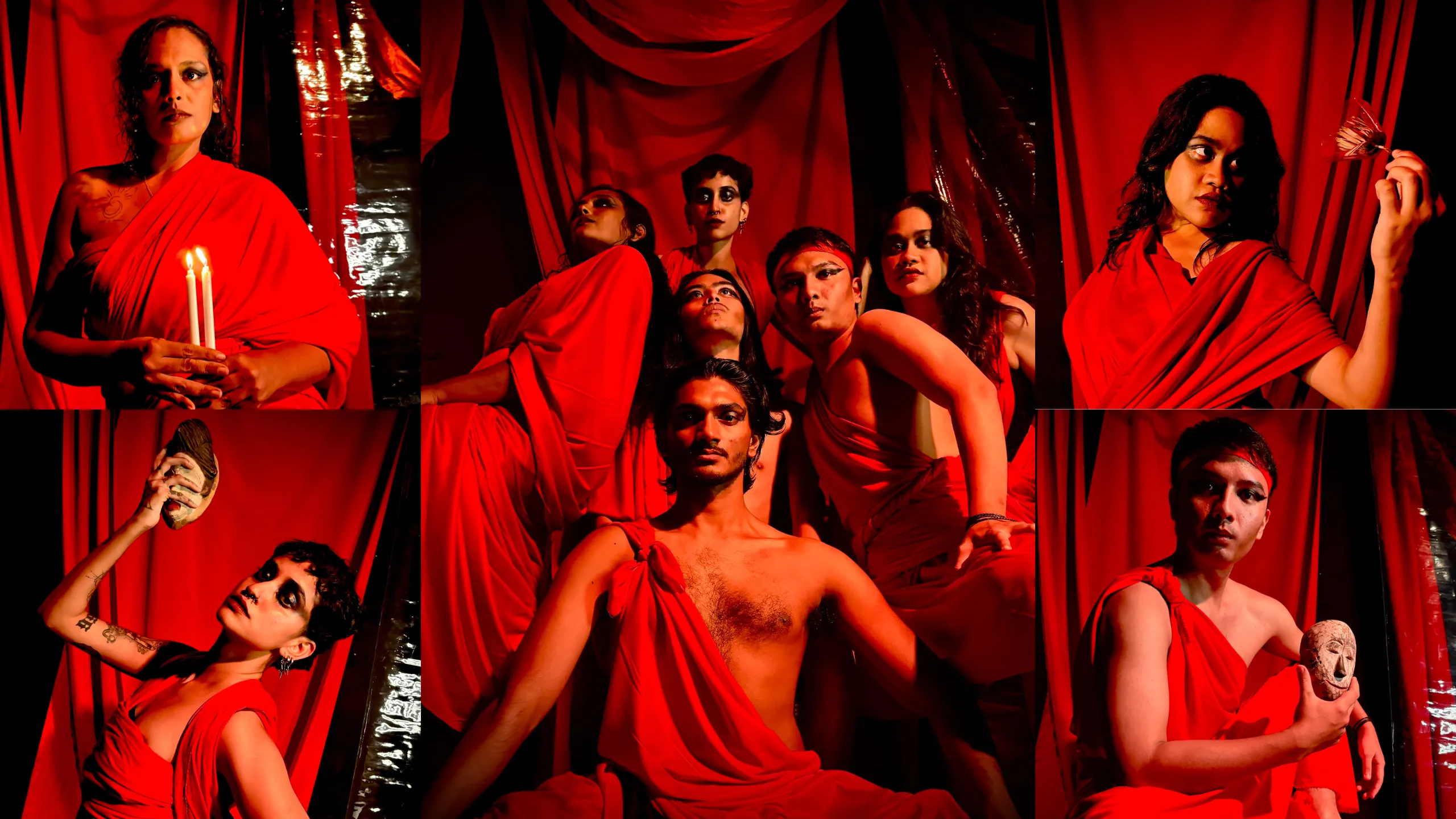
Scientific theories become frameworks for experimental theatre to explore philosophy and the subjective realities of the human experience in EJKLS Seni’s latest production, Socrates in D# Minor.
Written and directed by EJKLS Seni founder and artistic director, Asyraf Syahir, the play is an experimental tetralogy across four episodes, each centering around scientific theories as narrative vehicles.
Tickets start from RM20 and can be purchased here.
Through an email interview, I asked writer and director Asyraf Syahir some questions regarding his newest work.
Socrates in D# Minor tackles philosophy, reality, and the human experience through scientific frameworks. What do you think is the relationship between science and theatre, and why do you think this isn’t a common combination that’s often explored?
From a more general angle, I always think that arts, including theatre, and science are more interrelated than we think. And the only reason we always see them as juxtapositional is the dichotomous positioning of the two within our educational system.
That very dichotomy is what leads to the underexploration of their relationship/combination. I challenge myself by attempting to break that dichotomy.
Not simply going for a sci-fi route, but actually linking philosophical questions to these scientific theories. It’s about seeing the “human” and the “subjective” within a more “objective reality” angle.
The majority of the literature of these scientific concepts would be in English. As the play is in Bahasa Malaysia, did you experience any friction in translating these concepts for the stage?
Definitely. I find some “terms” sounding a bit more easily recognizable in English than its Malay translation.
For example, in the second episode of the play, I wanted to use the word “terrain”; and the translation of it will be “muka/rupa bumi.” But I feel like we barely use the “muka/rupa bumi” in normal daily conversations, and “terrain” would be a snappier word choice.
Nonetheless, keeping true to the language, the team decided to use the Malay word.
What inspired you to write and develop Socrates in D# Minor in the first place, and the story behind its four episodes?
The inspiration to develop this play comes from the first “episode” of the play – which was actually a playlet I wrote back in 2012 – Big Bang! It was actually originally written in English so when translating it to Malay, adjustments had to be made (especially for puns, innuendos, and wordplays).
From that first “episode”, I was inspired to write more stories inspired by scientific theories – which led to the second episode, another playlet called Evolusi which I wrote in 2017.
From there, I conceptualize an overarching episodic concept for a full length play that does not focus on one specific character but is anchored by a thematic cohesion, and thus the remaining episodes are born.
So we can say that Socrates in D# Minor is not just telling the stories of the characters, it also indirectly exhibits the subtle progression of how my writing and thinking has developed.
I feel like, and my actors agreed as well, from Episode I to Episode IV, the audience can see the complexity and philosophical standings of the script slowly become more complex and multifaceted.
And the story behind the title of the play, which seemed to suggest a more musical tone?
Basically, I was trying to anchor the title to an existential theorist but names like Kierkegaard and Jean Paul Sartre felt a bit too on the nose; and they also have very specific ideas of existentialism. While my plays are tied to existentialist ideas, it’s a looser definition, and I want to keep it loose so that I have the creative liberty to explore my own philosophical standpoints.
Then “Socrates” comes into picture.
While he would not have known of Existentialism as we know it today, his ideas have been linked by many modern scholars to be existentialist in nature. And also his famous quote, “the unexamined life is not worth living”, feels like one giant existentialist dilemma to me.
D# Minor is selected since it is musically an enharmonic pair to E-flat Minor whereby musicians generally prefer E-flat minor for being easier for notations and practical readability.
Hence, it is my way of saying that the play forces us to read life in a more complicated manner (which is not necessarily necessary, but it is also not theoretically wrong).
Put together, Socrates in D# Minor is about going through that difficult pathway to understand our very existence instead of blissfully living in it in ignorance.
As a director, how did you work with your cast in bringing your script to life, especially considering its more experimental and absurdist nature, for this particular production?
There’s a lot of choreographed movements in this play, and a specific rhythm and intonations to how the lines should be delivered. So when directing and practising for this play, it requires extreme precision from the actors.
I would say that for this play in particular, I take inspiration from Robert Wilson’s approach for Image Theatre and Edward Gordon Craig’s controversial uber-marionette approach in order to make the vision come to life (among many other techniques).
Of course, I personalize them to my own style. I’m quite lucky that I have a great ensemble – Nanda, Amal, Eunous, Ameen, Suba, and Har were able to capture the precision required in this play.
With the time that we have to work for this play, they have been showing crazy dedication to present the best version of it to the audience.
Like many of your other works, Socrates in D# Minor is a blackbox-style production, and as a PhD candidate, you’re also researching blackbox-style performances. Can you talk more about what attracts you to this particular theatre medium?
There’s this sense of intimacy, flexibility, and immersion that you can achieve with small spaces like the blackbox.
The proximity with the audience is smaller, facial expressions and micro-movements are more visible, and the space can be arranged in a more unconventional manner (which can always surprise the audience). Hence, there are some levels of details that matter more; that would matter less if it’s performed at bigger spaces. So these different crafts that are needed for blackbox-style theatre performances are what makes me particularly drawn to them.
Additionally, it also paves way for more stories to be told. Because of its small-scale nature, it would require less cost, and thus theatre becomes a more accessible medium for storytelling for more people.
Tickets for Socrates in D# Minor can be purchased here.
This interview has been edited for length and clarity.

Leave a Reply